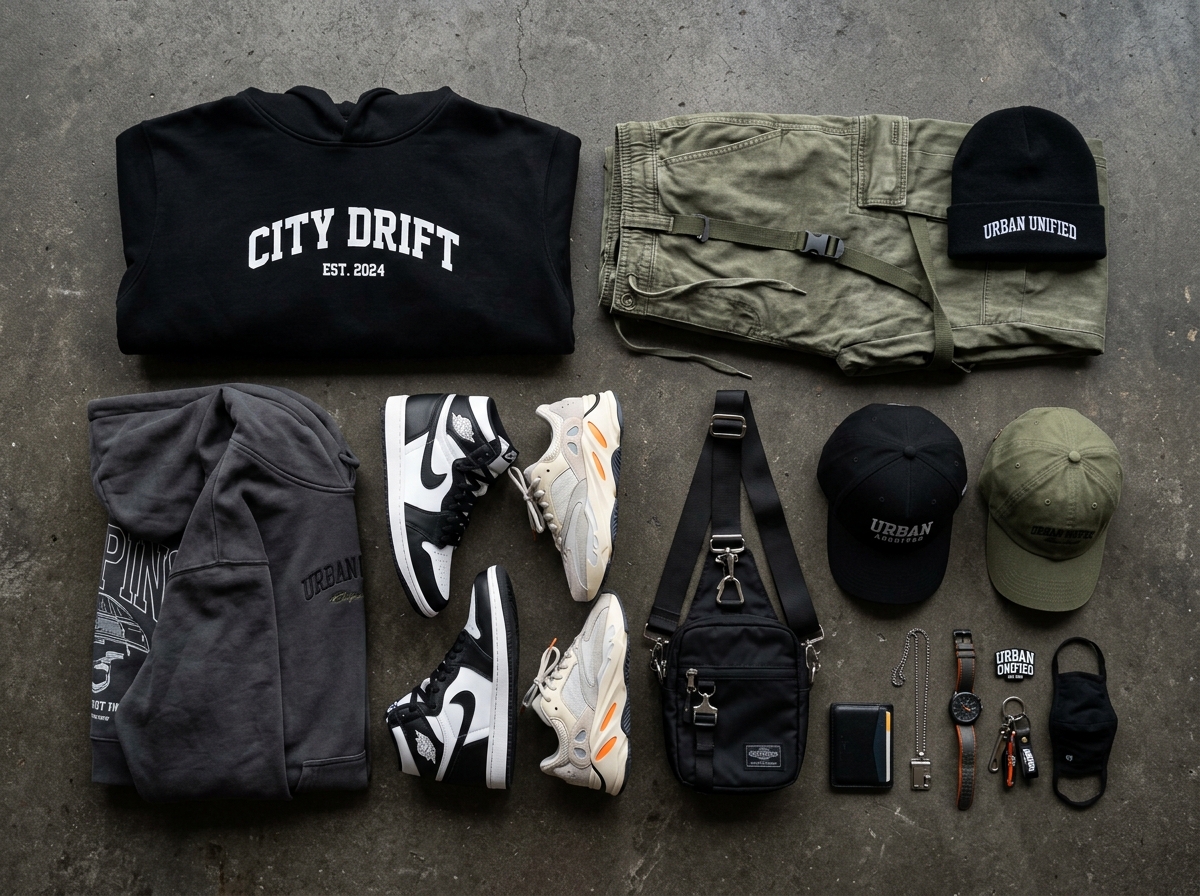
The 8-Piece Matrix Philosophy
By curating high-density fabrics, timeless neutral colorways, and mathematically compatible boxy cuts, 8 foundational garments can easily generate over 30 distinct, sophisticated streetwear outfits for work, leisure, and travel — eliminating closet clutter and decision fatigue permanently.
The Problem with Fast Fashion Clutter
The average consumer owns over 100 articles of clothing yet regularly wears fewer than 15% of them. Walk into any bedroom and you will find drawers overflowing with t-shirts bought on impulse, hoodies that lost their shape after the third wash, and trendy pieces that felt exciting for exactly one weekend before being banished to the back of the closet. This is the fast fashion trap, and it is both financially devastating and environmentally catastrophic.
Fast fashion promotes impulsive micro-trend purchasing: flimsy t-shirts constructed from 140 GSM single-ply cotton that warp after two washes, synthetics that pill within weeks, and trendy colorways that lose cultural relevance within three months. The result is a wardrobe that feels simultaneously overstuffed and inadequate — hundreds of garments, yet nothing that feels right when you are standing in front of the mirror at 7:30 in the morning trying to put together an outfit.
A minimalist streetwear capsule shifts the paradigm entirely, moving the focus from quantity to textile supremacy and silhouette permanence. Every single item in the 8-piece system is engineered to integrate seamlessly with every other piece, creating a mathematical matrix of outfit combinations that eliminates decision fatigue while elevating your baseline aesthetic to a level that most people only achieve when they are actively trying to impress someone.
The capsule approach is not about deprivation. It is about precision. It is the difference between owning a drawer full of disposable lighters and carrying a single, refillable, beautifully engineered lighter that works every single time you flick it. The capsule wardrobe is your sartorial equivalent of buying once, buying right, and never looking back.
The Eight Core Capsule Garments Detailed
Each garment in the capsule has been selected not just for its individual merit, but for its ability to harmonize with every other piece in the system. Think of these eight items as instruments in a jazz ensemble — each one can hold its own as a solo performer, but the real magic happens when they play together.
- The Heavyweight Blank White Tee (300 GSM): This is the bedrock foundation of every capsule wardrobe. We are not talking about the translucent, tissue-thin white tees you find in fast fashion stores. A proper 300 GSM heavyweight white tee features a razor-sharp ribbed collar that holds its shape through hundreds of wash cycles, zero backlighting transparency even under direct sunlight, and a clean drop-shoulder cut that creates architectural width across the upper body. The fabric should feel substantial in your hands — almost like holding a piece of canvas. This tee works equally well tucked into raw denim for a minimalist creative look or layered under a crewneck for texture depth.
- The Acid-Washed Charcoal Graphic Tee (280 GSM): Where the blank white tee is your canvas, the graphic tee is your statement. An acid-washed charcoal base delivers authentic subcultural texture and visual attitude without screaming for attention. The graphic should be understated — think tonal prints, abstract washes, or vintage-inspired typography rather than oversized logos or brand names plastered across the chest. At 280 GSM, this tee still carries weight and drape that separates it from cheap alternatives. It is your go-to for casual weekend days, concert outings, and any situation where you want your outfit to communicate personality without saying a single word.
- The Washed Black 500 GSM Hoodie: The hoodie is the gravitational center of any streetwear wardrobe, and at 500 GSM, this is not just a hoodie — it is a piece of armor. Heavy loopback cotton construction ensures the fabric develops a beautiful patina over time rather than degrading. The double-lined structured hood maintains its shape whether you wear it up or down, creating a clean silhouette from every angle. The kangaroo pocket should be reinforced with bartack stitching, and the ribbed cuffs should be snug enough to stay in place without cutting off circulation. This hoodie anchors any outerwear stack and serves as the foundational mid-layer for cooler months.
- The Sage Green or Slate Grey Crewneck Sweatshirt: The crewneck sweatshirt is perhaps the most versatile piece in the entire capsule. In sage green or slate grey, it bridges the gap between relaxed street comfort and smart casual office dressing with effortless grace. The key is in the construction: look for a brushed fleece interior for warmth, flatlock seaming for comfort against the skin, and a slightly oversized boxy fit that drapes cleanly without looking sloppy. A well-constructed crewneck in a muted earth tone can be worn to a coffee meeting, a gallery opening, or a Saturday morning farmers market with equal confidence.
- The 14 oz Relaxed Raw Indigo Denim: Raw denim is the slow-fashion equivalent of a fine wine — it gets better with age. At 14 ounces, the fabric is heavy enough to hold a clean silhouette but not so stiff that it feels like wearing cardboard. Japanese or Australian cotton denim is ideal, with a tight weave that resists fraying and develops personalized whisker patterns and honeycomb fades over months of wear. The fit should be relaxed through the thigh with a slight taper to the ankle, creating a gentle puddle break over your sneakers. Raw indigo pairs with literally every other piece in this capsule because of its neutral, universally flattering color profile.
- The High-Density Utility Cargo Trousers: Utility cargos have transcended their military origins to become a streetwear essential, and the right pair can elevate any outfit from casual to considered. Look for water-resistant cotton twill at 280 GSM or higher, flat accordion thigh pockets that sit flush against the leg when empty, and bungee hem cinches that allow you to adjust the silhouette from straight-leg to tapered on the fly. The colorway should be neutral — washed black, olive, or stone — to maintain maximum compatibility with the rest of your capsule. These trousers work with everything from a blank white tee for a minimal look to a layered hoodie-and-puffer stack for urban winter days.
- The Cropped Boxy Shell or Puffer Jacket: Outerwear is where many capsule wardrobes fail because people choose overly specific or trend-dependent jackets. A cropped boxy shell or lightweight puffer in matte black or dark olive is the solution. The matte exterior resists both water and the visual noise of shiny fabrics, while the lightweight thermal fill provides genuine cold-weather protection without the bulk that makes you look like a walking sleeping bag. The cropped length is critical — it should hit right at the waistband of your trousers, creating a proportional silhouette that lengthens the legs and keeps the overall outfit balanced.
- The Clean Retro Leather Low-Top Sneaker: Footwear is the foundation upon which every outfit literally stands, and the wrong pair of shoes can dismantle an otherwise perfect look in seconds. A clean retro leather low-top in white, off-white, or gum sole is the safest and most versatile choice. Avoid fluorescent accents, excessive branding, or chunky platform soles — the goal is a shoe that complements the outfit without competing with it. Full-grain leather ages beautifully, developing a natural patina that adds character over time. These sneakers should feel like the period at the end of a sentence: essential, understated, and perfect in their simplicity.
Generating Thirty-Plus Combinations from the Matrix
The mathematical beauty of the 8-piece capsule becomes apparent when you start mapping out combinations. Because all eight garments adhere to a cohesive neutral color story — washed black, charcoal, sage, optic white, raw indigo, olive — every top pairs naturally with any bottom. With three tops (white tee, graphic tee, crewneck), one mid-layer (hoodie), two bottoms (raw denim, utility cargos), one outerwear piece, and one footwear option, the combinatorial possibilities exceed thirty distinct outfit configurations. Here are some standout examples:
- Fit #1 — The Minimalist Creative: Blank white 300 GSM tee tucked into raw indigo denim with a leather belt, paired with clean white leather low-tops. This is the outfit that architects, designers, and creative directors have been wearing for decades because it communicates effortless competence without trying too hard.
- Fit #2 — The Urban Commuter: White tee as the base layer, sage crewneck as the mid-layer, utility cargo pants with hems cinched at the ankle, and leather low-tops. This layered look is ideal for unpredictable weather and long days that move from office to after-work drinks.
- Fit #3 — The Weekend Street Armor: Charcoal graphic tee under the 500 GSM washed black hoodie, cropped matte puffer jacket on top, raw indigo denim, and low-tops. This is maximum streetwear energy — three layers of heavyweight cotton and insulated outerwear creating a silhouette that commands attention.
- Fit #4 — The Smart Casual Evening: Slate crewneck sweatshirt over the white tee for a visible collar layer, utility cargos cinched at the ankle for a tailored look, and retro leather sneakers. Smart enough for a restaurant, casual enough for a rooftop bar.
- Fit #5 — The Monochrome Stack: Washed black hoodie over the charcoal graphic tee, utility cargos in black or olive, and leather sneakers. This tonal stack creates visual depth through texture rather than color, resulting in a look that feels curated and intentional.
- Fit #6 — The Transitional Layer: Graphic tee under the cropped puffer jacket with no mid-layer, raw denim, and low-tops. Perfect for autumn days when the morning is cold but the afternoon is warm — the puffer comes off to reveal the graphic tee underneath.
Understanding Fabric Weight and Why GSM Matters
GSM stands for grams per square meter, and it is the single most important metric for evaluating garment quality. Fast fashion t-shirts typically range from 120 to 160 GSM — fabrics so thin that they become translucent under overhead lighting and lose their shape after a handful of washes. The capsule wardrobe demands a minimum of 280 GSM for tees and 450 GSM or higher for hoodies and sweatshirts.
At 300 GSM, a t-shirt has enough weight to drape properly without clinging to the body, and the fabric density prevents the collar from stretching out. At 500 GSM, a hoodie develops the structured, architectural quality that separates premium streetwear from high-street basics. The cotton fibers are packed tightly enough to resist pilling, and the fabric thickness provides natural insulation that eliminates the need for multiple thin layers.
The relationship between GSM and longevity is not linear — it is exponential. A 300 GSM tee does not last twice as long as a 150 GSM tee. It lasts five to seven times longer because the denser weave distributes stress across more fibers, preventing the localized wear patterns that cause holes and thinning in lightweight fabrics. When you calculate cost-per-wear over a three to five year period, heavyweight garments are dramatically cheaper than their fast fashion equivalents.
Cost-Per-Wear Economics: The Real Math
The initial investment in a premium 8-piece capsule wardrobe ranges from $600 to $1,200, depending on brand and sourcing. This figure causes sticker shock for consumers accustomed to $15 fast fashion tees, but the cost-per-wear calculation tells a radically different story.
Consider a 500 GSM loopback hoodie priced at $120. Worn an average of twice per week — 104 times per year — over a conservative five-year lifespan, the cost per wear drops to $0.23. Compare this to a $30 fast fashion hoodie that pills, stretches, and fades within six months (approximately 50 wears), yielding a cost per wear of $0.60. The premium hoodie is literally three times cheaper to wear despite costing four times more to buy.
Multiply this calculation across all eight garments and the savings compound dramatically. Over a 36-month period, the capsule wardrobe owner spends roughly $800 to $1,200 total on clothing while the fast fashion consumer, constantly replacing degraded garments and chasing micro-trends, easily spends $2,000 to $4,000 on items that end up in landfill. The capsule approach is not just aesthetically superior — it is financially intelligent.
Seasonal Adaptation Without Expanding the Capsule
A common objection to the capsule wardrobe concept is seasonal variation. How can eight pieces cover summer heat, autumn transitions, winter cold, and spring unpredictability? The answer lies in layering strategy rather than garment multiplication.
In summer, the capsule reduces to its core: the heavyweight white tee or graphic tee paired with utility cargos or raw denim and low-top sneakers. The heavy GSM fabric actually performs better in heat than thin synthetics because cotton breathes and the weight prevents the fabric from clinging to perspiration. In autumn, the crewneck sweatshirt enters the rotation as a mid-layer, and the hoodie becomes an outer layer. Winter activates the full three-layer stack: tee, hoodie, and cropped puffer. Spring reverses the process, peeling layers as temperatures rise.
The critical insight is that you never need more than three layers at any given time, and all eight garments have been specifically chosen to function at every position in the layering hierarchy. The white tee is always the base. The crewneck or hoodie is always the mid. The puffer is always the outer. This predictability is not a limitation — it is freedom from the daily cognitive burden of outfit planning.
Maintenance and Longevity Protocol
A capsule wardrobe only delivers on its promise if the garments are properly maintained. Heavyweight cotton is remarkably durable, but it rewards careful treatment with even greater longevity. Always wash in cold water (30°C or below) to prevent fiber shrinkage and color bleeding. Turn garments inside out before washing to protect surface prints, embroidery, and face fabric from abrasion against the drum. Use a gentle detergent free from optical brighteners, which degrade dark dyes over time.
Air drying is non-negotiable for premium streetwear. Tumble dryers subject fabric to extreme heat and mechanical stress that accelerates fiber breakdown, collar stretching, and print cracking. Hang or flat-dry every garment, reshaping collars and cuffs while damp. Store hoodies and sweatshirts folded rather than hung to prevent shoulder bumps from hangers. Raw denim should be washed as infrequently as possible — once every 30 to 50 wears — to allow natural fade patterns to develop authentically.
With proper care, every piece in the 8-piece capsule will serve you faithfully for a minimum of three years, with hoodies and denim easily reaching five to seven years. That is not just a wardrobe — it is an investment in looking consistently excellent without ever overthinking what to wear.
Final Takeaway
The minimalist capsule streetwear wardrobe is not a compromise — it is an upgrade. Eight carefully chosen garments, built from premium heavyweight fabrics in a cohesive neutral palette, will generate more outfits, last longer, cost less per wear, and look better than a closet full of fast fashion impulse buys. Build your capsule once, maintain it well, and enjoy the freedom of never standing in front of your wardrobe feeling like you have nothing to wear again.