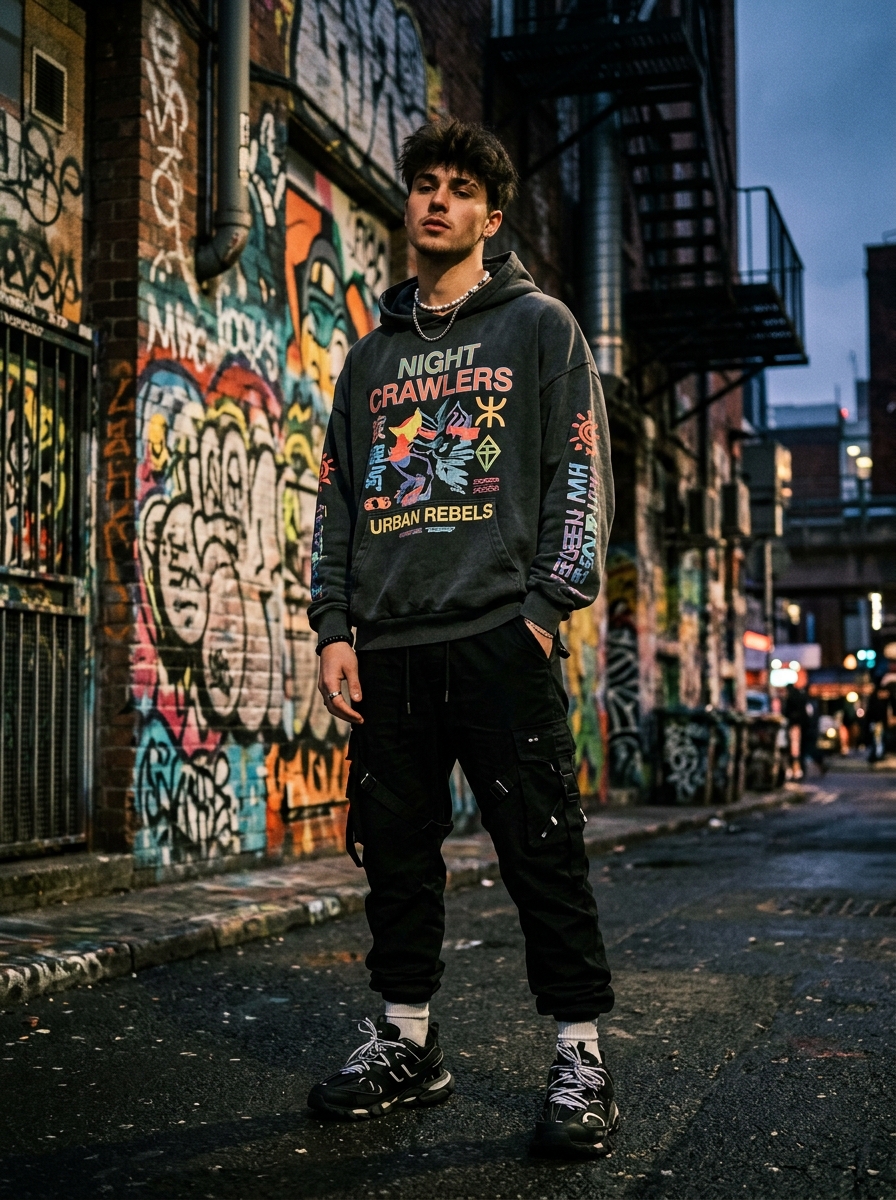
The Australian Streetwear Paradox
Australian street style is distinct from London, New York, or Tokyo: it must effortlessly adapt to rapid 15°C temperature swings, fierce Southern Ocean sea gusts, intense sunlight, and active metropolitan walking. The answer is modular, breathable layering built on heavyweight organic cotton — engineered for a city that can deliver four seasons before lunchtime.
The Cultural Roots of Melbourne Laneway Fashion
Melbourne's street fashion identity is globally recognized for its intellectual, subversive, and monochromatic edge. Unlike the logo-heavy flex culture of Los Angeles or the avant-garde experimentation of Tokyo's Harajuku district, Melbourne dressing prizes understated sophistication, textile quality, and cultural authenticity over loud, gaudy branding. It is a city where a perfectly constructed 500 GSM hoodie commands more respect than a designer logo, and where the way you layer your outfit communicates more about your taste than the price tags on your clothes.
The roots of this aesthetic trace back to the underground graffiti scene of Hosier Lane and Centre Place in the early 2000s, where street artists, skateboarders, and independent musicians created a visual culture that rejected commercial polish in favor of raw, authentic expression. This creative DNA merged with the specialty coffee revolution of Fitzroy and Collingwood — neighborhoods where baristas, graphic designers, and boutique owners needed clothing that looked considered but never tried too hard. The result was a street style dialect that favored washed blacks, muted earth tones, and heavyweight natural fabrics over bright colors and synthetic materials.
The core aesthetic is built on textural depth rather than chromatic variety. Think washed black loopback fleece paired with matte black utility twill, mineral-dyed charcoal tees peeking under deep olive overshirts, and raw white ecru accents providing subtle contrast. This subdued color story interacts harmoniously with Melbourne's physical environment — the historic bluestone alleyways, exposed red brick warehouses, Victorian-era cast iron facades, and contemporary concrete-and-glass architecture of the CBD. The clothing becomes an extension of the city itself, creating a visual coherence that makes well-dressed Melburnians look like they belong to their surroundings rather than standing apart from them.
Understanding Melbourne's Microclimatic Challenge
Melbourne's weather is not merely variable — it is aggressively unpredictable in ways that challenge even the most experienced dresser. The city sits at the convergence of cold Southern Ocean air masses and warm continental systems, creating microclimatic conditions that can shift temperature by 15 degrees within a single morning commute. You can leave your apartment at 8:00 AM in 10°C drizzle, walk through 18°C sunshine at 10:30 AM, experience a sudden 22°C burst of warm northerly wind at noon, and find yourself in a 12°C southerly change with horizontal rain by 3:00 PM.
This meteorological chaos is not an occasional inconvenience — it is the daily reality of Melbourne living for approximately eight months of the year. Traditional fashion advice (dress for the weather forecast) is useless in a city where the forecast changes three times before lunch. Melbourne demands a fundamentally different approach to dressing: a modular, layerable system where every garment can be added, removed, or reconfigured throughout the day without compromising the overall silhouette or aesthetic coherence of the outfit.
This is why Melbourne became the epicenter of Australian heavyweight streetwear culture. The thick, substantial fabrics that define premium streetwear — 300 GSM tees, 500 GSM hoodies, heavy canvas utility jackets — are not just aesthetic choices in Melbourne. They are functional necessities, providing genuine thermal insulation during cold snaps and enough structural weight to resist flapping and billowing during the city's notorious wind gusts.
The 3-Tier Weather Defense Protocol
To comfortably navigate a day that begins at 10°C with coastal drizzle and rises to 25°C with direct sunshine by 2:00 PM, employ the modular 3-tier streetwear protocol. This system is the backbone of Melbourne street style, and it is the reason why Melburnians consistently appear in global best-dressed street style lists despite living in one of the most weather-volatile cities on Earth.
- Tier 1 — Base Foundation: A 280 to 300 GSM boxy organic cotton t-shirt in washed black, charcoal, or off-white. The heavy yarn count is critical because this base layer must look complete, authoritative, and intentionally styled when worn alone — which it will be during warm afternoon hours when both outer layers have been removed. A lightweight base tee looks inadequate on its own; a heavyweight base tee looks like a deliberate outfit choice. The boxy cut ensures the tee does not cling to the body when perspiration accumulates during warm periods, maintaining the clean silhouette that defines Melbourne street style.
- Tier 2 — Thermal Mid-Layer: A 500 GSM unbrushed loopback cotton hoodie or crewneck sweatshirt. This is the workhorse layer — the garment that goes on and off most frequently throughout the day. The reverse cotton loops absorb moisture during brisk walking through the CBD while the thick exterior fabric blocks wind chill during southerly changes. When the afternoon sun warms the streets, this piece easily knots diagonally across the chest or drapes over the shoulders — a styling technique that Melbourne has elevated to an art form. The key is choosing a mid-layer that looks equally good worn normally, tied around the waist, or draped over the shoulders, which is why heavyweight construction is essential. A lightweight hoodie looks sloppy when tied around the waist; a 500 GSM hoodie looks intentional and sculptural.
- Tier 3 — Weather Shell: A cropped boxy nylon windbreaker, water-repellent coach jacket, or heavy canvas chore coat. This outer layer provides rain and wind defense during Melbourne's frequent weather changes. Kept unbuttoned or partially zipped, it creates visible stepped tiers that add visual depth and dimension to the overall silhouette. The cropped length is important — it should end at or slightly above the waistband, creating proportional balance with the relaxed-fit trousers that dominate Melbourne street style. Full-length coats create a formal, European silhouette that feels out of place in Melbourne's casual creative culture.
Neighborhood Style Breakdowns
Melbourne's street style varies significantly by neighborhood, reflecting the distinct creative communities that inhabit each area. Understanding these micro-variations helps you calibrate your outfit for specific social contexts.
Fitzroy and Collingwood are the creative heartlands — home to tattoo studios, vintage stores, independent galleries, and the third-wave coffee shops that put Melbourne on the global specialty coffee map. The style here is the most relaxed and subcultural: oversized vintage band tees under open canvas chore coats, raw denim with aggressive puddle breaks over classic skate shoes, and acid-washed or mineral-dyed hoodies in muted purple, sage, or dusty pink. Graphic tees are acceptable here — even encouraged — as long as the graphics communicate genuine subcultural affiliation rather than mainstream brand loyalty.
The CBD and Southbank require a slight elevation in formality without abandoning streetwear foundations. This is where the smart-casual bridge becomes essential: clean heavyweight blank tees under structured crewneck sweatshirts, utility cargos with cinched hems for a tailored silhouette, and clean leather low-top sneakers rather than beaten-up skate shoes. The color palette tightens to true blacks, charcoals, and navy, reflecting the architectural glass-and-steel environment and the creative-professional demographic that populates the area during business hours.
South Yarra and Prahran lean toward a more polished, fashion-forward interpretation of streetwear. This is Melbourne's commercial fashion corridor, home to Chapel Street boutiques and designer concept stores. The style here incorporates more fashion-forward proportions — wider-leg trousers, platform soles, and more experimental layering — while maintaining the heavyweight fabric foundation and muted color story that defines Melbourne street style at large. Accessories play a larger role here: minimal jewelry, structured caps, and premium sunglasses add finishing details that the other neighborhoods treat as optional.
Brunswick and Northcote represent the DIY, sustainability-focused end of the spectrum. This is where organic cotton certifications, ethical manufacturing, and second-hand vintage actually matter to the community. The style is deliberately anti-fashion: oversized, broken-in, patina-rich garments that have been worn and washed dozens of times until they develop a soft, lived-in character. New clothing is viewed with mild suspicion; well-worn heavyweight pieces with visible fade patterns and softened collars are the ultimate status symbols.
Bluestone Footwear and Pavement Strategy
Melbourne's urban grid requires walking thousands of steps across uneven bluestone pavers, tram tracks, and damp bitumen on a daily basis. Unlike the flat, uniform sidewalks of most modern cities, Melbourne's heritage bluestone surfaces are irregular, often rain-slicked, and surprisingly hard on the feet after extended walking. Your footwear selection must deliver high shock absorption, reliable wet traction, and genuine all-day comfort without sacrificing streetwear credibility.
Classic vulcanized skate shoes remain the most popular choice across all Melbourne neighborhoods. The flat, grippy rubber outsoles provide excellent traction on wet bluestone, while the canvas or suede uppers develop a beautiful patina with wear that aligns perfectly with Melbourne's appreciation for lived-in aesthetics. Gum-sole suede court sneakers offer a slightly more refined option for CBD and South Yarra settings, providing the same traction benefit with a cleaner visual profile. Cushioned retro basketball silhouettes with thick EVA midsoles are ideal for days involving extended walking — the additional cushioning prevents the foot fatigue that plagues wearers of thin-soled minimalist sneakers on hard stone surfaces.
When pairing footwear with Melbourne's dominant relaxed-fit trouser silhouettes, ensure the pant hem achieves either a deliberate slight puddle break or sits cleanly on the tongue without dragging on wet sidewalks. The worst scenario in Melbourne is a trouser hem that drags through puddles and tram-track water channels — it destroys the fabric, stains the hem, and looks fundamentally unintentional. Either commit to a clean zero break above the shoe or a deliberate full puddle that stacks intentionally above the sole.
Transitioning from Studio to Laneway Dining
The ultimate test of a Melbourne streetwear outfit is day-to-night versatility. A single outfit must feel natural in a creative design studio at 11:00 AM, an art gallery opening at 5:30 PM, and a dim-lit natural wine bar or laneway restaurant in the CBD at 9:00 PM. This is not a hypothetical challenge — it is a typical Tuesday for many creative professionals in Melbourne, and it is the practical constraint that has shaped the city's street style into its current form.
The 3-tier system handles this transition elegantly. During work hours, the full three-layer stack communicates professionalism without formality — structured enough for meetings but relaxed enough for studio work. At the gallery opening, the outer shell comes off and the hoodie becomes the primary visible layer, creating a more casual, approachable look appropriate for social settings. At the wine bar, the hoodie ties around the waist or drapes over the chair back, leaving the heavyweight tee as the sole upper garment — simple, clean, and perfectly appropriate for an intimate evening setting. Three distinct looks, zero outfit changes, one cohesive garment system.
By keeping color palettes dark and graphics subtle, your heavyweight silhouette carries a refined, adaptable aura suitable for any urban setting Melbourne throws at you. This is the fundamental insight that separates Melbourne street style from other global streetwear capitals: it is not about having the most interesting outfit in the room. It is about having an outfit that works in every room, from morning to midnight, from drizzle to sunshine, from studio to bar.
Seasonal Adjustments for the Melbourne Calendar
While the 3-tier system works year-round, seasonal adjustments optimize comfort and visual weight for Melbourne's distinct climate periods. Summer (December to February) sees temperatures regularly exceeding 35°C with intense UV radiation. The layering system reduces to Tier 1 only — a heavyweight blank tee, relaxed shorts or lightweight utility cargos, and canvas sneakers. Ironically, the heavyweight tee performs better in extreme heat than lightweight alternatives because the dense cotton absorbs perspiration rather than becoming transparent and clingy.
Autumn (March to May) is peak Melbourne layering season — the 3-tier system operates at maximum effectiveness during this period. Daily temperature swings are at their most extreme, and the ability to add and remove layers is not just convenient but essential. This is also the season when Melbourne's fashion scene is most active, with gallery openings, music festivals, and outdoor dining creating constant social occasions that demand versatile, well-considered outfits.
Winter (June to August) introduces the full layering stack with upgrades: heavier weight outer shells (lined canvas chore coats or insulated bombers), thicker mid-layers, and potentially a fourth thermal base layer for Melbourne's coldest mornings. Footwear shifts toward water-resistant options — treated leather boots or gore-tex lined sneakers — as winter rainfall increases significantly. The color palette naturally deepens, with true blacks and deep charcoals dominating as the city's grey winter light eliminates the warm undertones that make earth tones pop during warmer months.
Final Takeaway
Melbourne's street style is not a trend — it is a practical response to one of the world's most challenging urban climates, refined over two decades of creative community building. Master the 3-tier modular layering system, invest in heavyweight organic cotton, keep your palette dark and your graphics subtle, and you will have a wardrobe that handles everything Melbourne can throw at you while looking effortlessly considered at every hour of the day.