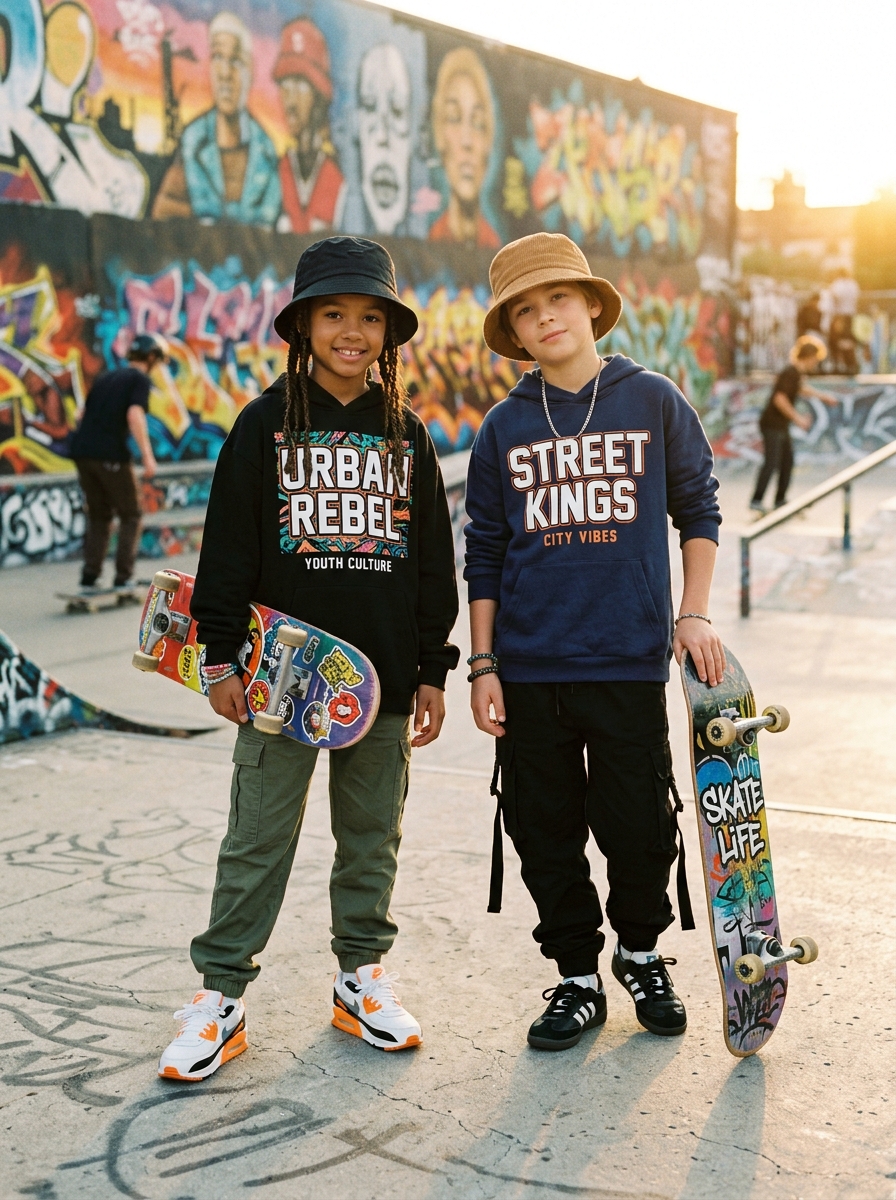
Streetwear as Youth Culture Heritage
Children's and youth streetwear is no longer cheap, downscaled adult merchandise with cartoon graphics. It is an authentic cultural movement rooted in skateboarding, active freedom of movement, non-toxic natural textiles, and generational durability. When we equip the next generation with authentic heavyweight streetwear, we pass down an appreciation for craftsmanship, self-expression, and sustainable consumption.
The Cultural Lineage: Skateboarding as the Crucible of Streetwear
Streetwear was not invented in boardroom focus groups or luxury design studios in Paris. It was born in the coastal skateparks, empty swimming pools, and asphalt schoolyards of Venice Beach, California, in the 1970s and 1980s, before spreading to the gritty urban laneways of Melbourne, London, and Tokyo. At its heart, streetwear has always been the uniform of youth rebellion, physical creativity, and outsider camaraderie.
Skateboarders needed clothing that fulfilled very specific physical demands: heavy cotton t-shirts that absorbed asphalt abrasions during failed kickflips, loose-fitting trousers that allowed unrestricted hip and knee mobility for high-impact landings, and durable hoodies that provided thermal protection during evening sessions under streetlights. Logos and graphics were badges of subcultural affiliation — signaling membership in an authentic creative tribe rather than commercial consumerism.
By 2026, as skateboarding stands officially recognized on the global Olympic stage, the cultural ethos of skate streetwear has been passed down to a new generation of parents and children. Today's youth are not interested in synthetic, disposable fast-fashion garments featuring licensed cartoon characters; they want the authentic textures, heavyweight fabrics, and architectural cuts that their parents wear — clothing that respects their physical energy, autonomy, and developing sense of personal style.
Engineering for Extreme Abrasion: The Skatepark Test
Youth apparel experiences physical stresses that would shred ordinary commercial clothing within weeks. A single afternoon at an urban concrete skatepark involves coarse grip-tape friction (which acts like 80-grit sandpaper against fabric), repeated asphalt slides, high-impact knee drops, and constant tugging during active playground sports. Standard 140 GSM fast-fashion children's wear simply cannot survive this environment.
Authentic youth streetwear applies heavy-duty engineering principles borrowed from industrial workwear and military uniforms:
- Double-Layer Knee Reinforcement: Cargo pants and skate trousers feature dual-layer fabric panels extending from mid-thigh to the lower shin. If the outer cotton twill layer is abraded against concrete during a slide, the inner structural layer remains intact, preventing embarrassing blowouts and protecting the wearer's skin.
- Four-Needle Flatlock & Bartack Seaming: High-stress zones — including the crotch gusset, armhole seams, and pocket corners — are reinforced with dense bartack stitching (typically 28 to 42 stitches per cluster). This prevents seams from bursting during deep knee bends, skateboarding tricks, and rough-and-tumble play.
- Heavyweight 260 to 320 GSM Cotton Jersey: By using thick, ring-spun combed cotton for youth t-shirts, the fabric possesses high tensile tear resistance, enduring hundreds of abrasive friction cycles without developing holes.
- Reinforced Collar Ribbing: Youth necklines endure aggressive stretching as children dress and undress themselves rapidly. Elastane-bound 2x2 ribbing ensures collars bounce back instantly without stretching into distorted ripples.
Skin Health and Non-Toxic Textile Chemistry
Children and adolescents have thinner, more permeable skin than adults, with a higher body-surface-area-to-weight ratio. This biological reality makes youth significantly more vulnerable to the toxic chemicals and synthetic finishes commonly found in cheap commercial fast fashion.
Mass-market children's clothing frequently contains hazardous chemical residues, including formaldehyde resins (used to prevent wrinkling), nonylphenol ethoxylates (NPEs, industrial surfactants), heavy metal mordants in cheap synthetic dyes, and synthetic plasticizer phthalates in plastisol graphics. When children perspire during vigorous outdoor activity, their pores open and absorb these trace toxins, leading to contact dermatitis, eczema flare-ups, and allergic skin sensitivities.
True luxury youth streetwear eliminates these risks through strict adherence to GOTS-certified (Global Organic Textile Standard) organic cotton and OEKO-TEX Standard 100 certifications. The cotton is grown without synthetic pesticides or defoliants, milled without toxic chlorine bleaches, and colored using water-based, non-toxic reactive dyes. Furthermore, graphic prints utilize water-based discharge or non-phthalate inks that breathe naturally with the fabric. The result is pure, hypoallergenic comfort that allows children to play, sweat, and live without toxic chemical exposure.
The Boxy Drop-Shoulder Pattern: Designing for Growth
One of the most persistent frustrations for parents is the speed at which growing children cycle through clothing sizes. A traditional slim-fit children's t-shirt or hoodie purchased in March is often unwearably tight and short by September, turning wardrobe management into an expensive, wasteful cycle.
The engineered boxy drop-shoulder cut solves this problem naturally through intelligent geometry. Because a boxy streetwear cut features a dropped shoulder (8 to 12 cm past the shoulder joint) and a generous chest width, the garment adapts fluidly as the child grows:
- Year 1: The garment fits with an intentional, fashion-forward oversized drape — sleeves stacked comfortably at the wrists (anchored by firm ribbed cuffs) and the hem falling cleanly over the hips.
- Year 2: As the child gains height and shoulder width, the dropped seam naturally shifts closer to the shoulder bone, transitioning into a relaxed, boxy everyday fit.
- Year 3: The garment transitions into a classic cropped boxy silhouette, pairing effortlessly with high-waisted utility cargos or shorts.
Generational Durability and the Hand-Me-Down Economy
In our grandparents' era, children's clothing was crafted from durable wool, heavy canvas, and dense cotton, designed to be passed down through three or four siblings before being repurposed into quilts or work rags. Fast fashion destroyed this circular tradition, replacing it with flimsy polyester garments that unravel after five washes and end up in municipal landfills within a year.
Heavyweight youth streetwear revives the proud tradition of generational durability. When a 450 GSM loopback cotton hoodie or 14 oz raw denim jacket is outgrown after three years of skateboarding and park exploration, the garment is not worn out — it is beautifully broken in. The fabric has developed an authentic, vintage patina; the collar remains razor-sharp; the seams are structurally flawless.
These pieces pass seamlessly to younger siblings, cousins, or local community clothing swaps, retaining their aesthetic value and functional performance across multiple generations of children. This is true circular sustainability: creating garments so durable, timeless, and culturally authentic that they refuse to become waste.
Fostering Conscious Consumption from an Early Age
Clothing is more than fabric — it is a daily, tactile education in values. When children grow up wearing disposable $8 fast-fashion t-shirts that are discarded the moment they get stained or stretch out, they are subtly conditioned into a disposable mindset that treats material resources, labor, and the planet as infinitely expendable.
Conversely, when a young person is given ownership of five or six beautifully made, heavyweight foundation pieces — learning how to wash them in cold water, hang them to dry, and take pride in their longevity — they develop an intuitive respect for craftsmanship, textile quality, and conscious consumption. They learn that true style is not about having fifty cheap options in a messy closet; it is about owning a curated collection of premium garments that feel incredible against the skin and stand up to any adventure.
The Five-Piece Next-Gen Streetwear Starter Capsule
Building a complete, high-performance youth streetwear wardrobe requires only five versatile foundation garments:
- The 280 GSM Boxy Heavyweight Blank Tee: In optic white, washed black, or sage green. Featuring an elastane-reinforced collar that survives hundreds of pulls.
- The 450 GSM Double-Layer Loopback Hoodie: Unbrushed French terry with an upright crossover hood and reinforced kangaroo pocket.
- The Double-Knee Relaxed Utility Cargo: Heavy cotton twill with adjustable elastic waistband and bungee hem cinches that adapt to growth spurts.
- The 12 oz Relaxed Selvedge Denim: Roomy through the thigh with an elastic internal button-adjust waistband and slight taper at the ankle.
- The Cropped Boxy Wind Shell / Coach Jacket: Water-repellent matte nylon with snap-button closure for rainy skatepark mornings.
A Parent's Blueprint: Measuring for the Boxy Youth Cut
When selecting streetwear for growing kids, traditional numerical age sizing (e.g., "Size 8" or "Size 12") can be misleading due to natural variations in childhood growth rates. Instead, take three physical measurements with a soft tape measure:
- Chest Circumference (Pit-to-Pit): Measure horizontally across the fullest part of the child's chest. Add 8 to 12 cm to the flat measurement to determine the ideal boxy garment chest width. This extra volume provides the authentic drop shoulder and ensures the child has full freedom of movement for skateboarding, climbing, and running.
- Shoulder Width (Acromion-to-Acromion): Measure straight across the back from shoulder bone to shoulder bone. A true youth streetwear tee or hoodie should feature a shoulder span that is 6 to 10 cm wider than the child's shoulder measurement, allowing the seam to drop naturally midway down the upper arm.
- Total Garment Body Length: Measure from the side base of the neck down to the top of the hip bone. Avoid longline tops that extend down past the mid-thigh, as excess length inhibits leg stride during sports and skateboard pushes.
Skatepark Safety: Seamless Protective Padding Integration
One of the greatest functional advantages of relaxed-fit streetwear is its seamless compatibility with essential skatepark safety gear. Tight commercial jeans and slim joggers cannot accommodate protective knee pads or hip impact shorts without painful pinching and seam tearing.
Relaxed-fit double-knee cargo pants and wide-leg denim provide generous interior volume, allowing low-profile knee pads, shin guards, and impact shorts to be worn comfortably underneath the trousers. This keeps safety gear securely in place during high-speed bowl runs while preserving a clean, unencumbered streetwear silhouette on the exterior. Similarly, 450 GSM loopback hoodies provide enough internal room to wear lightweight chest and back protection during vert ramp sessions.
The Parent's Stain Removal Guide for Active Youth
Active kids subject their clothing to heavy outdoor grime. Use these non-toxic spot-cleaning protocols to keep organic cotton looking pristine:
- Fresh Green Grass Stains: Mix equal parts white vinegar and warm water. Dab onto the stain with a clean cloth, let sit for 15 minutes, then apply a drop of liquid dish soap and rub gently in circular motions before washing in cold water.
- Skatepark Asphalt & Bicycle Chain Grease: Dust the grease spot heavily with baking soda or cornstarch to draw out petroleum oils. After 20 minutes, brush away the powder, apply a drop of dish soap directly to the fibers, and rinse thoroughly with cold water.
- Mud & Wet Soil: Allow mud to dry completely into a crust (never rub wet mud, which spreads fine silt into the cotton weave). Once dry, brush off the crust with a stiff-bristled brush, then wash on a normal cold cycle.
The Psychology of Youth Self-Expression Through Streetwear
Adolescence is the pivotal developmental stage where young individuals begin constructing their independent identities and discovering their creative voices. For decades, traditional school uniforms and mass-market children's clothing imposed rigid conformity from above.
Streetwear offers young people an empowering canvas for self-determination. By selecting their own silhouettes, curating neutral color palettes, experimenting with layered tiers, and understanding fabric craftsmanship, youth learn to express their individuality with confidence. Streetwear teaches them that true presence comes from authenticity, physical capability, and understated quality — foundational life lessons that extend far beyond their wardrobes.
Seasonal Youth Streetwear: Modular Climate Layering
Children are in constant motion throughout the day — running during school recess, sitting in air-conditioned classrooms, and sweating at outdoor skateparks in the afternoon. Youth streetwear must adapt modularly to rapid body temperature fluctuations:
- Summer Sun & Skatepark Sessions: A 260 GSM organic cotton drop-shoulder blank tee paired with relaxed cotton twill utility shorts (hitting right above the knee to allow unhindered knee pad clearance). Heavy natural cotton absorbs sweat during active play without becoming transparent or clinging to the back.
- Autumn Morning Commutes & Afternoon Sports: The classic 2-layer youth stack: 260 GSM base tee under an unbuttoned lightweight cotton canvas coach jacket, paired with double-knee relaxed cargos. When the afternoon sun warms the playground, the coach jacket snaps around the waist.
- Winter Cold & Wet Weather Defense: The 3-tier defense stack: heavyweight base tee, 450 GSM double-layer loopback hoodie, and a water-repellent hooded windbreaker. The double-layer hood provides genuine ear and neck warmth, eliminating the need for scratchy synthetic beanies that kids frequently lose.
The Youth Footwear Foundation: Grip, Durability & Support
Footwear for active youth must withstand extreme physical abuse while protecting developing feet and joints. Choose shoes that satisfy three functional criteria:
- Vulcanized or Cupsole Rubber Outsoles: Cupsole construction provides deep heel cushioning and impact absorption for jumping off stairs and skate obstacles, while vulcanized rubber delivers maximum board feel and grip on wet asphalt.
- Reinforced Suede & Leather Uppers: Canvas uppers tear rapidly against skateboard grip tape. Insist on genuine split suede or reinforced leather along the toe box (the ollie zone) and lateral side panels.
- Padded Tongue and Ankle Collars: Generous foam padding around the Achilles tendon and ankle bone prevents bruising from stray skateboard decks and playground equipment.
Circular Wardrobe Education: Teaching Kids to Value Craftsmanship
Equipping young people with heavyweight organic streetwear is an invaluable opportunity to teach circular sustainability and pride in craftsmanship. Involve children in the maintenance of their clothing:
Teach them to turn their graphic hoodies inside out before washing, show them how to lay their tees flat on the drying rack, and involve them in brushing dried mud off their double-knee cargos. When children see how durable, high-quality garments maintain their shape and comfort over years of rough-and-tumble adventures, they develop an instinctual appreciation for slow fashion, mindful consumption, and environmental stewardship that stays with them into adulthood.
Final Takeaway
Next-generation youth streetwear is an authentic celebration of skate heritage, physical freedom, non-toxic craftsmanship, and circular longevity. By investing in heavyweight organic cotton, double-layer reinforced construction, and growth-adaptable boxy cuts, we provide our children with apparel that withstands the real world while teaching them to value quality over disposability.